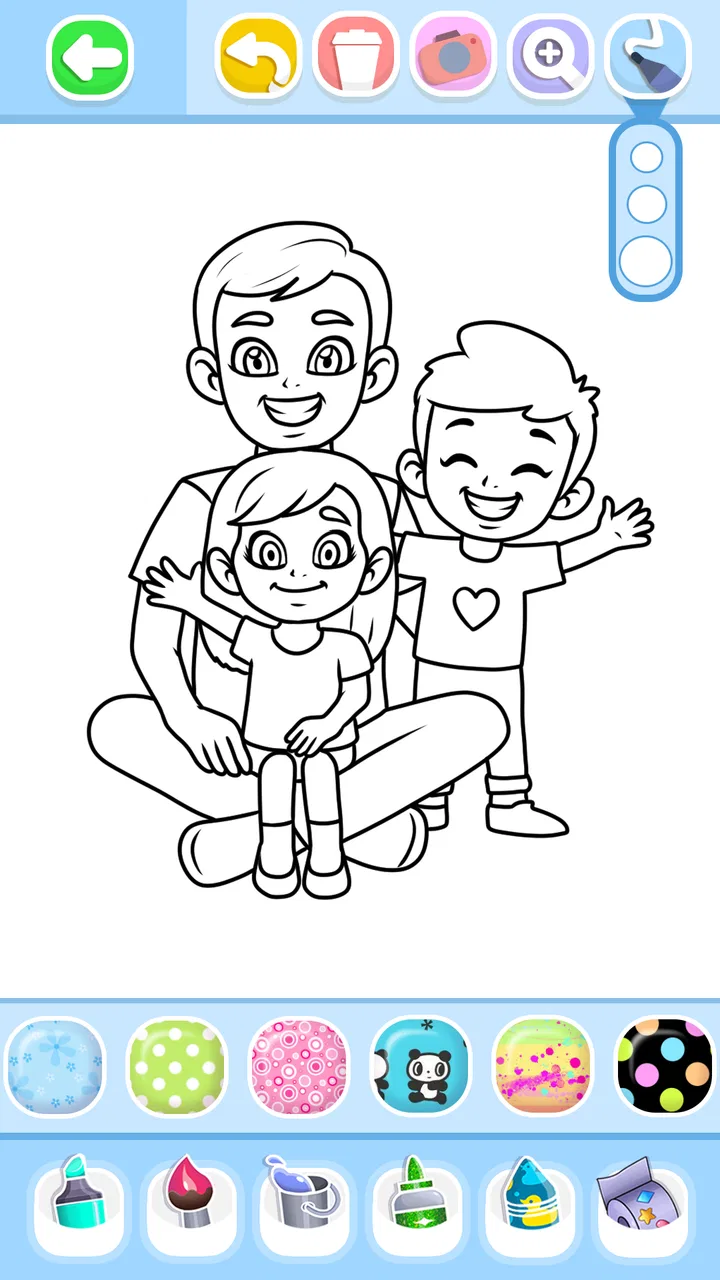
Family Love Coloring Book
- 3.5
- Rating
- 1.00M
- Installs
- Free
- Price

 Analysis by App-foxy
I approached Family Love Coloring Book as a small family activity rather than as a full creative suite. That distinction matters. The app sits in the parenting category, comes from FunKidStudio, and is free to start, so it is easy to bring into a quiet afternoon, a waiting-room moment, or a short activity before bedtime. Its central idea is simple: use coloring as a shared way for family members to slow down and spend time together.
My first impression was that this is aimed at accessibility rather than artistic complexity. The Everyone age rating makes it suitable for a broad household, including children who may not be ready for more complicated creative tools. At the same time, adults can join in without feeling that the activity is strictly a preschool exercise. The strongest part of the concept is not the coloring alone; it is the opportunity to turn a screen-based task into a conversation about family, feelings, and imagination.
From a spare moment to a finished family picture
I find a short coloring session works best when it has a small, realistic goal: choose one picture, let the child make the main decisions, and leave time to talk about the result. That keeps a spare moment from turning into aimless screen time and gives the activity a natural stopping point. It also sets up the next question: what happens when the child wants to keep going or the family is using the app together?
You May Also Like

 Blood Strike: 2.5 Anniversary
Blood Strike’s Loadouts Turn Every Drop Into a Tactical Gamble
A close look at Blood Strike’s custom loadouts: how fast access to signature weapons reshapes its battle royale rhythm, rewards preparation, and narrows the gap between fights.

 Pandora - Music & Podcasts
Pandora’s Music Is Easy to Start, but Harder to Recover
Pandora’s strength is its low-effort path from a seed to a station. Its weak spot is how much confidence it asks you to place in connection, setup, and quiet recovery.

 8 Ball Pool
 Is Built on Rivalries, Rematches, and Routine
A close look at the rivalries, rematches, shared routines, and unanswered safety questions that turn a quick pool match into a persistent mobile community.

 Samsung Music
’s Quiet Strength Is Playing What You Already Own
Its reach comes less from spectacle than from dependable access to a personal library. That simplicity is both the app’s strongest retention engine and its ceiling.

 AccuWeather: Weather Radar
AccuWeather Review: A Quick, Clear Forecast for Everyday Decisions
For everyday plans, the best forecast is the one you can understand quickly. AccuWeather makes rain timing, radar, and local conditions easy to act on, with a few trade-offs.

 Hill Climb Racing
Why Hill Climb Racing Still Turns Crashes Into One More Run
A tiny car, a bumpy hill and one more upgrade: Hill Climb Racing keeps resurfacing because its simple chaos makes every near-miss feel personal.
More From Our News Desk



Starting with the right expectation
The best way to use this app is to begin with a clear purpose. If I want a sophisticated drawing environment, detailed brush control, or a serious digital illustration workspace, this would not be my first choice. I would look toward a dedicated art app instead. Family Love Coloring Book makes more sense when the goal is a low-pressure activity that a child and an adult can understand quickly.
That starting condition changes how satisfying the experience feels. A parent who opens it expecting a large professional coloring library may find the idea limited. A parent looking for something that can occupy a child while still allowing participation will probably appreciate the straightforward approach more. I found it most useful when I treated the coloring page as a prompt for interaction instead of something that had to be completed perfectly.
The app is free, which removes the biggest barrier to trying it. There are in-app purchases ranging from $0.99 to $3.99 per item, so I would still check the purchase flow before handing the device to a child. That is a practical household step: decide whether the child is choosing only from the available material or whether an adult will manage optional purchases. Clear boundaries make the activity calmer and avoid turning a creative session into a negotiation.
Moving through a typical coloring session
My suggested workflow is simple. First, I choose a quiet moment and put the device where both the child and adult can see it. Then I let the child select the picture or color direction where possible, rather than taking over immediately. The adult’s role is better as a partner: ask what the picture represents, suggest unusual color choices, and help when a small control becomes frustrating.
That shared approach is more valuable than simply passing over the phone. When a child colors alone, the app can become another short distraction. When an adult stays involved, the picture becomes a starting point for questions such as “Who is in this family?” or “What would make this scene feel happy?” Those questions are not built-in features that I would credit to the software, but they are the most effective way I found to get more from its theme.
A useful trick is to give each person a small role. One person can choose the main colors, another can decide the background, and the child can explain the story behind the finished image. This prevents the adult from filling every area simply because they can work faster. It also gives the child ownership of the result, which is especially important when the child is still developing confidence with creative tasks.
I would avoid treating the coloring page like a test of accuracy. If a child colors a familiar object in an unexpected shade, I would ask about the choice rather than correct it. The app works best when the lack of pressure is part of the experience. That is a specific advantage over worksheets or printed coloring pages that adults sometimes use with an implied expectation that the child should stay inside every line.
How the handoff works between child and adult
The handoff from adult to child is where many family apps either become genuinely useful or lose their purpose. With this one, I would begin by demonstrating one action, then let the child try. I would not keep the device in my hands while explaining every possibility. The child needs enough control to feel that the picture belongs to them.
For younger children, the adult may need to manage navigation and leave the actual color decisions to the child. That division works well during a short session: the parent handles the parts that require reading or careful tapping, while the child handles the creative choices. Older children can usually take more responsibility, but I would still stay nearby if the device includes optional purchase prompts.
Another practical handoff is between siblings. Instead of letting the first child complete everything, I would assign turns by area or by decision. One child might choose the colors for people, while another handles the surroundings. This can reduce arguments, although it may not suit children who prefer complete control over their own pictures. In that case, separate turns are likely better than forcing a joint image.
The adult-to-child handoff also matters emotionally. If the child becomes frustrated, I would pause rather than immediately finish the difficult section. A short break, a change of color, or a new picture can preserve the sense that coloring is enjoyable. The app is not a replacement for a parent’s judgment, and its simple format means the quality of the session depends heavily on how the adult frames it.
Turning the finished image into an outcome
The result I value most is not a technically polished picture. It is a completed moment that gives the family something to talk about afterward. Once the child finishes, I would ask them to name the picture, describe the people or characters in it, and explain why particular colors were chosen. This turns a passive ending into a small storytelling exercise.
For example, imagine a parent waiting at home while dinner is being prepared and a child wants attention immediately. Instead of offering an unrelated video, the parent can sit down for a short coloring session. The child chooses the main image, the parent helps with navigation, and both discuss what makes the scene feel like a loving family. When dinner is ready, the child has not only passed the time; they have a picture and a story to share.
That scenario also shows the app’s practical limit. It is most successful when an adult contributes a few minutes of attention. If the expectation is completely hands-off entertainment, the family theme loses much of its value. A child may still enjoy tapping through colors, but the deeper benefit comes from the interaction around the image.
I would also use the finished picture as a transition activity. A parent could move from coloring into a bedtime conversation, asking the child to invent a short story about the people shown. Alternatively, the picture could become a prompt for a family drawing on paper. The digital activity does not need to end when the screen closes; it can hand the child an idea to continue elsewhere.
Where it fits beside familiar alternatives
Compared with a printed coloring book, this app is more convenient when the family already has a phone or tablet nearby. There is no need to find crayons or clear a table, and changing colors is less messy. The trade-off is that a screen can introduce distractions and removes the tactile feel of paper. For children who benefit from physical movement and sensory play, printed pages may be the better choice.
Compared with a general drawing app, Family Love Coloring Book has a more focused emotional theme. A blank canvas offers greater freedom, but it can also leave a young child unsure where to begin. A coloring format provides a starting point. On the other hand, children who already enjoy inventing their own characters may outgrow a guided coloring experience quickly and prefer a tool with broader drawing controls.
Compared with a video, the app asks for active choices rather than passive viewing. That makes it a better fit when a parent wants a calmer shared activity. It is not necessarily better for every situation, though. If a child is overtired and needs a very short, quiet distraction while an adult handles an urgent task, a video may be easier to manage. This app rewards participation, so it should be chosen when participation is realistic.
Useful habits for parents and caregivers
I would establish the purchase rule before opening the app. Since optional items cost between $0.99 and $3.99, an adult should decide whether purchases are allowed and who confirms them. This is not about making the activity feel restrictive; it simply keeps the child focused on coloring instead of on unlocking something new.
I would also set a clear stopping point. A short session can feel complete if the child knows the goal is to finish one picture or make three color decisions. Without a stopping point, the activity may drift into repeated tapping and become less meaningful. The app’s family angle is easier to preserve when the device is treated as one part of the routine, not the entire routine.
For children who struggle with open-ended questions, I would offer two choices instead of asking for unlimited imagination. “Should the sky be blue or orange?” is easier than “What should you do next?” Once the child becomes comfortable, the choices can become more creative. This gradual approach makes the app useful for children who enjoy coloring but hesitate when asked to explain their ideas.
Another non-obvious use is to let the child lead a short review of the finished picture. The adult can ask what was easy, what was annoying, and what they would change next time. That gives parents insight into whether the controls are comfortable for the child without turning the activity into a formal evaluation. It also helps identify when a paper coloring book or a more advanced art app would be a better fit.
Where the flow breaks down
The experience can break down when the adult assumes that a family-themed app automatically creates family interaction. It does not. If everyone is busy with separate tasks, the child may use it alone, and the emotional value becomes much smaller. I would not choose this as a substitute for direct attention when the child is specifically asking to play together.
It can also be a poor match for children who dislike coloring within prepared designs. Some children want to draw freely, erase often, or build scenes from nothing. A guided coloring format may feel repetitive to them. In that situation, a blank drawing canvas, physical craft supplies, or a construction-based activity would offer more room for personal control.
Parents should also consider device sharing. If the family has only one phone and the adult needs it for messages or work, the session may be interrupted. That interruption is more disruptive here than in a background video because the value depends on a shared flow. I would use a device that can stay available for the duration of the activity rather than beginning when I know I will need to take it back immediately.
The app’s average rating is 3.6 from around 500 ratings, while it has passed one million installs. I read that combination as a sign of broad curiosity and mixed individual experiences rather than as a reason to dismiss it. It has clearly reached many families, but the moderate average suggests that expectations matter. Someone looking for a simple family coloring activity may be satisfied, while someone expecting a deep art tool may judge it more harshly.
The current version is 9, and it runs on Android seven or later. That makes it accessible on a range of older Android devices, although the actual comfort of use will still depend on the screen and the device’s responsiveness. I would test it briefly on the intended family device before planning a group activity, especially if a child becomes frustrated by delayed taps or a crowded display.
Who should try it, and who should skip it
I would recommend it to parents seeking a gentle, easy-to-explain activity for a child, especially when the aim is shared time rather than artistic training. It can also suit grandparents, babysitters, and older siblings who want a structured prompt for conversation. The Everyone rating supports its broad household appeal, but the adult should still choose the pace and level of help that fits the child.
I would be more cautious about recommending it to families who want extensive creative control, a tactile craft experience, or a completely independent activity with no adult involvement. Those users may be happier with paper supplies, a general drawing application, or a more feature-rich art program. The free entry point makes trying it easy, but free does not mean it will match every family’s preferred style.
My closing view after following the full workflow
Family Love Coloring Book works best when the journey is deliberate: start with a short shared moment, let the child make meaningful choices, hand over control instead of taking over, and finish by talking about the picture. In that workflow, the app becomes more than a collection of digital colors. It becomes a simple prompt for attention and storytelling.
My recommendation is therefore positive but specific. I would keep it in a parent’s toolkit for low-pressure family activities, not present it as a complete art platform or a substitute for hands-on play. FunKidStudio has chosen a focused idea, and the focus is its strength. The experience is most rewarding when adults accept its simplicity, manage optional purchases carefully, and remain part of the activity.
If you want an easy starting point for coloring and conversation, this app is worth trying; if you want deep drawing controls or hands-off entertainment, choose something else. Its free starting point lowers the risk, while the family-centered format gives it a purpose that a generic coloring tool may not provide. The final picture matters, but the shared process is the real reason I would recommend keeping it available.
FAQs for Family Love Coloring Book
01What is Family Love Coloring Book and who is it designed for?
Family Love Coloring Book is a creative app designed for users of all ages who enjoy coloring and art. It's particularly suited for families who want to spend quality time together, as it features a variety of family-themed illustrations. The app is intuitive, making it easy for both kids and adults to use.
02What features does Family Love Coloring Book offer?
The app offers a wide range of features including a diverse selection of family-themed coloring pages, various coloring tools like brushes and color palettes, and the option to save and share your artwork. There are also calming background music and hints for those who seek inspiration while coloring.
03Is Family Love Coloring Book available for both Android and iOS devices?
Yes, Family Love Coloring Book is available for download on both Android and iOS platforms. You can find it on the Google Play Store for Android devices and the Apple App Store for iOS devices, ensuring compatibility with most smartphones and tablets.
04Are there any in-app purchases in Family Love Coloring Book?
Family Love Coloring Book offers a free version with basic features, but there are optional in-app purchases available. These purchases can unlock additional coloring pages, tools, and ad-free experiences. This allows users to enhance their coloring experience according to their preferences and budget.
05How does Family Love Coloring Book ensure a family-friendly experience?
The app is designed with family-friendly content, ensuring that all illustrations and features are appropriate for all ages. It includes parental controls to manage in-app purchases and time spent on the app, providing a safe and enjoyable environment for children and adults alike.
Pros
- Wide variety of coloring pages.
- User-friendly interface.
- Great for stress relief.
- Includes daily updates.
- Suitable for all ages.
Cons
- Contains ads during use.
- Limited free pages.
- Requires internet for updates.
- Some colors need purchase.
- Occasional app crashes.

Family Love Coloring Book
Gallery